
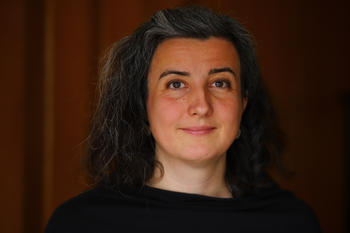
PD Dr. Magdalena Waligórska
Humboldt-Universität zu Berlin
Institut für Europäische Ethnologie
Anton-Wilhelm-Amo-Str.41
10117 Berlin
I am a cultural historian and sociologist. My fields of interest include: contemporary Polish and Belarusian history, Jewish/non-Jewish relations, Holocaust studies, nationalism and national symbols, Jewish heritage and popular culture, music and identity, and memory studies.
I studied literature, cultural studies and sociology at the Jagiellonian University in Kraków, Poland and Högskolan Dalarna in Sweden. I obtained my PhD from the European University Institute in Florence (Department of History and Civilization) in 2009. I was a Humboldt Fellow at the Free University in Berlin (2011-2013) and assistant professor of Eastern European History and Culture at the University of Bremen (2013-2020). In 2021 I obtained my /Habilitation/ in Modern History at the University of Hamburg. I have published extensively on Jewish culture, Jewish-non-Jewish relations and nationalism. My first book, /Klezmer’s Afterlife: An Ethnography of the Jewish Music Revival in Poland and Germany/, appeared with Oxford University Press in 2013. My second book is a cultural history of the symbol of the cross in the Polish political imagination: /Cross Purposes: Catholicism and the Political Imagination in Poland/ (Cambridge University Press, 2023).
Current Project
ERC-Consolidator Grant: PLUNDERED LIVES // Intimate Dispossession: The Afterlives of Plundered Jewish Personal Possessions in the Aftermath of the Holocaust
This project aims to write the history of the great plunder of small things—everyday household objects, and personal items, including clothing, looted on a mass-scale by local non-Jews during, and in the aftermath of, the Holocaust. While historical research has focused on the top-down and centralized Nazi state’s takeover of Jewish financial assets, real estate, businesses, or art objects, we know nothing about the afterlives of unmarked objects of daily use that changed hands in the course of the Holocaust and continued being used for decades in the small local communities of East-Central Europe. The main objectives of the project are to document different modes of how Jewish personal possessions were appropriated by non-Jewish local populations of East-Central European shtetls; examine how they have been redeployed, adapted, and misused by their new owners; and assess the social and psychological trans-generational impact of this kind of plunder on the communities of both the beneficiaries and the victims. Breaking with the top-down view on Holocaust dispossession, this project focuses on eight microstudies of communities located in three different administrative units of German-occupied East-Central Europe. PLUNDERED LIVES’ novelty is in a combination of a microhistorical analysis with qualitative approaches of social studies and social psychology; extending the typical time frame (1939-1945) to include dispossession practices that continued after WWII; and experimental outreach strategies of digital crowdsourcing, curatorial interventions in public spaces, and cross-generational interviewing to elicit responses from the implicated communities and document hitherto inaccessible material in private possession. Highly interdisciplinary, PLUNDERED LIVES will open avenues for future research into the fields of genocide studies, anthropology of conflict, social psychology, economic history and forensic studies.
Monographs
2023: Cross Purposes: Catholicism and the Political Imagination in Poland, Cambridge: Cambridge University Press.[The Bronisław Malinowski Award in the Social Sciences from PIASA]
Reviews: Slavic Review (2025), H-Soz-Kult (2024)
2013: Klezmer’s Afterlife. An Ethnography of the Jewish Music Revival in Poland and Germany, Oxford: Oxford University Press.
Reviews: Slavic Review (2014), New Eastern Europe (2014), Association for Jewish Studies Review (2014), Music and Letters (2014), East European Jewish Affairs (2014), H-Net (2015), Yearbook for Traditional Music (2015)
Edited Volumes
2025: [with Franziska Exeler] Special Issue of Holocaust Studies: After the Void, vol. 31 no. 3.
2025: [with Erica Lehrer and Roma Sendyka] Special Issue of Holocaust and Genocide Studies: Awkward Objects of the Holocaust, published online first, June 2025.
2019: (with Simon Lewis) Special Issue of East European Politics and Societies and Cultures “Poland’s Wars of Symbols” vol. 33, no 2.
2018: (with Tara Kohn) Jewish Translation/Translating Jewishness (Berlin: DeGruyter).
2014: Żydowskość w przekładzie [Jewishness in Translation Theme Issue of the Polish Journal of Literary Translation] Przekładaniec: A Journal of Translation Studies, Kraków: Wydawnictwo Uniwersytetu Jagiellońskiego [in Polish].
2013: Music Longing and Belonging. Articulations of the Self and the Other in the Musical Realm, Newcastle: Cambridge Scholars Publishing.
2010: (with Sophie Wagenhofer) Cultural Representations of Jewishness at the Turn of the 21st Century, EUI Working Papers, Florence: European University Press.
Journal Articles
2026: "Intimate Dispossession': The Theft of Jewish Clothes during and after the Holocaust" POLIN: Studies in Polish Jewry, vol 38, Gender and the Body in East European Jewish History, edited by Elissa Bemporad, Joanna Degler, Francois Guesnet and Antony Polonsky, https://doi.org/10.3828/POLIN.2026.38.307.
2025: “Intimate Dispossession as a Form of Violence: Holocaust Plunder of Jewish Personal Belongings in East-Central Europe” Journal of Modern European History, https://doi.org/10.1177/16118944251409629.
2025: “Collecting the Holocaust: Private Collections of Holocaust Mementos in Post-1945 Central and East-Central Europe” Holocaust and Genocide Studies, published online 31 July 2025, DOI: 10.1093/hgs/dcaf019.
2025: “Topos of the Jewish Treasure in Postwar Polish, Belarusian and Ukrainian Shtetls” Holocaust Studies, vol. 31, no. 3, 2025, 498-516.
2025: [with Marta Duch-Dyngosz, Alexander Friedman und Ina Sorkina] “A History of Overwriting: Jewish Cemeteries in Postwar Poland, Ukraine and Belarus,” Holocaust Studies, vol. 31, no. 3, 2025, 469-497.
2025: [with Natalia Aleksiun, Franziska Exeler und Yechiel Weizman] “Round Table Discussion: After the War: Beginning Life Anew in the Aftermath of Violence” Holocaust Studies, vol. 31, no. 3, 2025, 546-561.
2023: [with Ina Sorkina] “The Second Life of Jewish Belongings--Jewish Personal Objects and their Afterlives in the Polish and Belarusian Post-Holocaust Shtetls” Holocaust Studies, 2023, vol. 29, no. 3, 341–362, DOI: 10.1080/17504902.2022.2047292 [Holocaust Studies Journal Prize for the Best Research Article of the Year 2023]
2023: (with Yechiel Weizman, Ina Sorkina, Alexander Friedman) “Holocaust Survivors Returning to their Hometowns in the Polish-Belarusian-Ukrainian Borderlands, 1944-1948,” Journal of Holocaust Research 37:2, 191-212, DOI:10.1080/25785648.2023.2197759
2023: „Anti-Jewish Violence of Polish Troops 1918–1920: The Case of Bobruisk“, Eastern European Jewish Affairs, vol. 2, 2023.
2022: (with Ina Sorkina) “Rückkehr nach Hause oder ´Repatriierung´? Beweggründe für die Migration bei Holocausüberlebenden in Belarus nach dem Zweiten Weltkrieg: Eine vergleichende Betrachtung” Münchner Beiträge zur Jüdischen Geschichte und Kultur, vol. 1/2022, 65-82.
2020: “The Klezmer Revival in Poland as a Contact Zone”, in: POLIN: Studies in Polish Jewry, vol. 32, 461-476.
2019: “On the Genealogy of the Symbol of the Cross in the Polish Political Imagination”, in: East European Politics and Societies and Cultures, vol. 33, 2, 497-521.
2019: (with Simon Lewis) “Poland’s Wars of Symbols”, in: East European Politics and Societies and Cultures, vol. 33, 2, 423-434.
2019: „Stettin, Szczecin und der ‚dritte Raum‘ – Erinnerung im deutsch-polnisch-jüdischen Grenzland“, in: Totalitarismus und Demokratie, vol. 16, 1, 39-59.
2018: “Remembering the Holocaust on the Fault Lines of East and West-European Memorial Cultures: The New Memorial Complex in Trastsianets, Belarus”, in: Holocaust Studies vol. 24, 3, 329-353. [Annual Article Prize of Holocaust Studies]
2018: “Памяць пра халакост на лініях разломаў паміж усходне- і заходнееўрапейскай мемарыяльнымі культурамі: новы мемарыяльны комплекс у Трасцянцы”, in: Arche, vol. 3, 80-96.
2015: “Jewish Heritage and the New Belarusian National Identity Project”, in: East European Politics and Societies, 20, 10, 1-28.
2014: “Healing by Haunting: Jewish Ghosts in Contemporary Polish Literature”, in: Prooftexts: A Journal of Jewish Literary History 34, 207-231.
2014: “Przekład żydowski/ żydowskość w przekładzie”, in: Przekładaniec: A Journal of Translation Studies, vol. 29, 7-19.
2014: “The Framing of the Jew. Paradigms of Incorporation and Difference in the Jewish Heritage Revival in Poland”, in: Jewish Cultural Studies, vol. 4, 313-31.
2013: [with Erica Lehrer] “Cur(at)ing History. New Genre Art Interventions and the Polish-Jewish Past”, in: East European Politics and Societies, 3, August, 507-540. DOI: 10.1177/0888325412467055.
2013: “The Jewish-Style Whodunit in Contemporary Poland and Germany”, in: East European Jewish Affairs, vol 43, 2, 143-161. DOI:10.1080/13501674.2013.813129.
2008: “Fiddler as a Fig Leaf. The Politicisation of Klezmer in Poland”, in: Manfred Sapper et al, eds., Osteuropa. Impulses for Europe. Tradition and Modernity in East European Jewry, Berlin: Osteuropa, 2008, 227-38.
2008: “Der Fiedler als Feigenblatt. Die Politisierung des Klezmers in Polen”, in: Osteuropa, Bd. 58, 8-10, 395-407.
2006: [with Steven Saxonberg] “Klezmer in Kraków: Kitsch, or Catharsis for Poles?”, in: Ethnomusicology, vol. 50, 3, 433-51.
2005: “A Goy Fiddler on the Roof. How the Non-Jewish Participants of the Klezmer Revival in Kraków Negotiate Their Polish Identity in a Confrontation with Jewishness”, in: Polish Sociological Review, vol. 4, 150, 367-82.
Book chapters
2024: “The Detritus of the Shtetl” in Natalia Romik, Justyna Koszarska-Szulc and Barbara Kirshenblatt-Gimblett, eds. (post)Jewish. Shtetl Opatów through the Eyes of Mayer Kirshenblatt, Warsaw: POLIN Museum, 2024, 261-76.
2023: (with Ina Sorkina and Alexander Friedman) “Jewish Heritage Revival in the Polish-Belarusian-Ukrainian Borderlands and the Myth of Multiculturalism” In: Simon Lewis and Stanley Bill (Eds.) Multicultural Commonwealth: Diversity and Difference in Poland-Lithuania and Its Successor States, Pittsburgh: Pittsburgh University Press, forthcoming.
2023: „Verlorene Städte – Untersuchungen zu den Schtetlech im polnisch-belarusisch-ukrainischen Grenzgebiet der Nachkriegszeit“ Martin Zimmermann, ed. Lost Cities. Vom Leben mit verlassenen Städten in den Kulturen der Welt (= Schriften des Historischen Kollegs, Kolloquien, Bd. 110). De Gruyter/Oldenbourg: Berlin/Boston.
2020: „Im Land der unerzählten Geschichten“, in: Thomas M. Bohn und Marion Rutz, Belarus-Reisen: Empfehlungen aus der deutschen Wissenschaft, Wiesbaden: Harrassowitz Verlag, 217–30.
2019: “Healing by Haunting: On Jewish Ghosts, Symbolic Exorcism and Traumatic Surrealism”, in: Zuzanna Dziuban, The “Spectral Turn”: Jewish Ghosts in the Polish Post-Holocaust Imaginaire, Bielefeld: Transcript Verlag, 107-130.
2018: (with Tara Kohn) “Jewish Translation / Translating Jewishness”, in: Waligórska, Magdalena und Tara Kohn (Ed.). Jewish Translation/Translating Jewishness, Berlin: DeGruyter, 1-14.
2018: “The Boundaries of Translation: Polish-Jewish-German Literary Borderlands”, in: Waligórska, Magdalena und Tara Kohn (Ed.) Jewish Translation/Translating Jewishness, Berlin: DeGruyter, 303-309.
2015: “Stettin, Szczecin, and the ‘Third Space.’ Urban Nostalgia in the German/Polish/Jewish Borderlands”, in: Lehrer, Erica und Michael Meng (Ed.), Constructing Pluralism: Space, Nostalgia, and the Transnational Future of the Jewish Past in Poland, Bloomington: Indiana University Press, 90-114.
2015: “In the Cellars and Attics of Memory: Mapping Jewish and non-Jewish Spaces in Contemporary Poland”, in: Gromova, Alina et al. (Ed.), Jewish and Non-Jewish Spaces in the Urban Context. Berlin: Neofelis, 243-258.
2015: [with Erica Lehrer] “A Picnic Underpinned with Unease: Spring in Warsaw and New Genre Polish-Jewish Memory Work”, in: Popescu, Diana und Tanja Schult (Ed.), Revisiting Holocaust Representation in the Post-Witness Era, London: Palgrave Macmillan, 149-162.
2014: “‘Darkness at the Beginning.’ Holocaust in Contemporary German Crime Fiction”, in: Herzog, Todd und Lynn Kutch (Ed.), Tatort Germany: The Curious Case of German Crime Fiction, Rochester: Camden House, 101-119.
2013: „Darstellungen des Jüdischen in der polnischen und deutschen Klezmer-Szene“, in: Nemtzov, Jascha (Ed.), Jüdische Musik. Studien und Quellen zur jüdischen Musikkultur, Bd. 11. Harrassowitz Verlag, 219-242.
2013: “Introduction: Music and the Boundaries of (Non)Belonging”, in: Waligórska, Magdalena (Ed.), Music, Longing and Belonging. Articulations of the Self and the Other in the Musical Realm, Newcastle: Cambridge Scholars Publishing, 1-10.
2012: “Performing Jewish History in a Museum. Three Models of Enactment and Visitor Participation”, in: Bala, Elisabeth, Gudrun Cyprian und Gaby Franger (Ed.), Sehen und gesehen werden, Frauen in der Einen Welt: Nürnberg, 98-103.
2009: “Spotlight on the Unseen: the Rediscovery of Little Jerusalems”, in: Murzyn-Kupisz, Monika und Jacek Purchla (Ed.), Reclaiming Memory. Urban Regeneration in the Historic Jewish Quarters in Central Europe, International Cultural Centre: Kraków, 99-116.
2008: “Reflektorem w zapomniane: odkrywanie małych Jerozolim”, in: Murzyn-Kupisz, Monika und Jacek Purchla (Ed.), Przywracanie pamięci. Rewitalizacja zabytkowych dzielnic żydowskich w miastach Europy Środkowej, International Cultural Centre, Kraków, 99-116.
2007: “Jewish Heritage Production and Historical Jewish Spaces: A Case Study of Kraków and Berlin”, in: Siauciunaite, Jurgita und Larisa Lempertiene (Ed.), Jewish Space in Central and Eastern Europe. Day-to-Day History, Manchester: Oxford Scholars Publishing, 225-50.
Reviews and other short texts
2021: (with Alexander Friedman) “Das Amt für Öffentliche Sicherheit (UB) und jüdische Kommunisten in der Volksrepublik Polen nach 1945. Der Fall Aleksander Kuc (1919-2005)“ Medaon: Magazin für jüdisches Leben in Forschung und Bildung, 15.
2017: “Vilnius/Vilne/Wilno/Vilna: A Short History of Overwriting”, H-Nationalism: H-Net Reviews, February 2017.
2017: “Review of Warsaw: The Jewish Metropolis, eds. Dynner/Guesnet“, Vierteljahrschrift für Sozial- und Wirtschaftsgeschichte, 2017.
2016: „Gardening the Nation: The Curious Case of Belarusian Nationalism Review of Rudling, Per Anders, The Rise and Fall of Belarusian Nationalism, 1906-1931. H-Nationalism, H-Net Reviews. August, 2016.
2015: “Kriegssocken: Biografien aus dem Krieg“, In: Gaby Franger Kriegssocken und Peacemakerinnen (Nürnberg: Frauen in der einen Welt, 2015), 58-59.
2014: “Ben-Yehudah – the Belorusian Hero”, in: AJS Perspectives, Spring.
2014: “Review of Małgorzata Pakier’s The Construction of European Holocaust Memory: German and Polish Cinema After 1989”, in: Nord-Ost-Archiv 23, 245-247.
2014: “Review of ‘In Search of Polin: Chasing Jewish Ghosts in Today’s Poland by Gary S. Schiff”, in: East European Jewish Affairs, May,134-136.
2013: “Granice przekładu: druga skóra pamięci”/ „Die Grenzen der Übersetzung: die zweite Haut der Erinnerung”, in: Magazin Deutschland und Polen, Goethe-Institut Polen, 2013.
2012: “Zbawczy kosmopolityzm. Michael Meng: Shattered Spaces: Encountering Jewish Ruins in Postwar Germany and Poland, Harvard University Press, 2012” Borussia: Kultura, Historia, Literatura, vol. 52, 232-37.